“Sue Kim describes her sibling Simon as the “party boy,” and herself as the more introverted, studious nerd.”
BY JANET MERCEL
“DON’T WORRY” — the sunshine-bright neon letters can be seen from where I’m sitting far below in Bar Chimera, or from the street outside, even from a passing cab. They can be seen, one might imagine, clear to Park Avenue. Perched under a sixty-foot-high ceiling that would tempt a trapeze artist, it is a literal sign to all the neatly turned-out professionals lined up on their bar stools and filling the cushy banquettes to leave their work problems at the door.
The bartender mixes my martini, tossing an icy poof of liquid nitrogen across the bar like a James Bond villain. While considering tasting a 19th-century vintage madeira, or an original 1992 cask vodka, we survey the artwork. Martin Creed’s fluorescent “Work No. 3936 DON’T WORRY” is one of three installations from the Turner Prize–winner — a coup for any collection, and the first commission in the U.S. (Creed’s “Feelings” hangs over the bed of billionaire super-collector Dakis Joannou on his Jeff Koons–painted superyacht.)
“When we first got the job, we were just here all the time,” says curator Rosa Suehyun (Sue) Kim. “Every time of day, every different day of the week. We wanted a good understanding of the building, how people interact there, how it looked on weekends.” Her partner, Ji Park Kwak, adds, “I rode a cab past it at night to see the view from a car. I walked my dog down the block at all hours.”
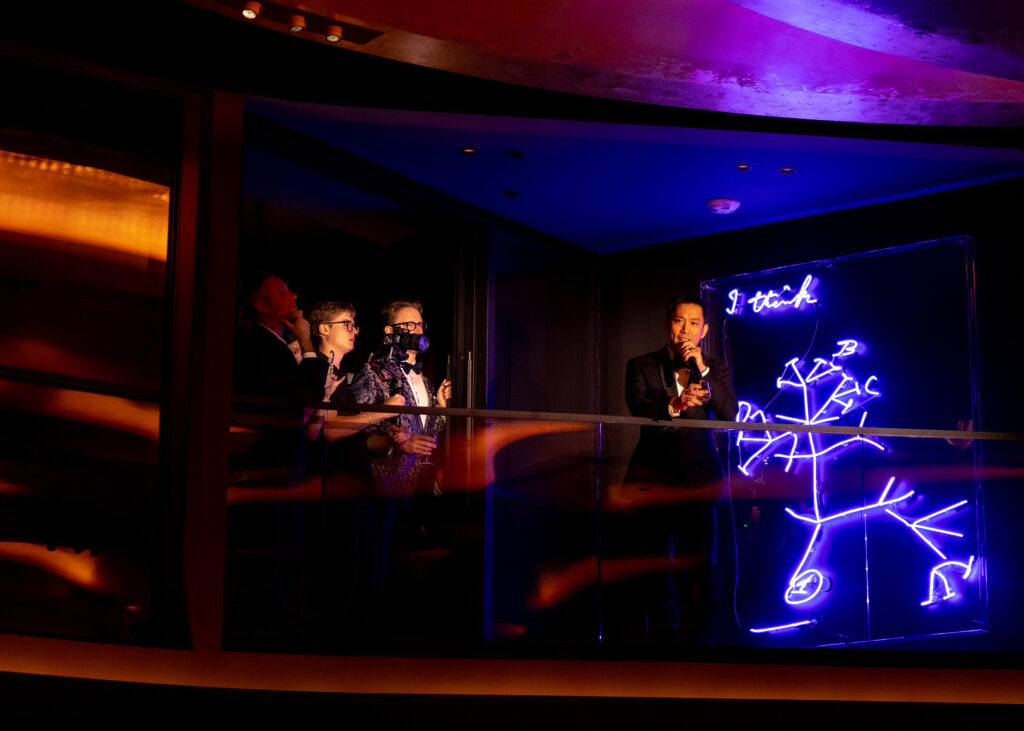
Sue Kim and Kwak make up ARTLINE, the public art consultancy known for making COTE outposts from Manhattan to Miami to Vegas into semi-private blue chip viewing spaces, with a specialty for placing cheeky works in unexpected places — either hidden in nooks that sneak up on you, or couldn’t-miss-it-if-you-tried highlights. In the first New York COTE, they curated text-driven works from Barbara Kruger, Ed Ruscha, Tracey Emin. At COTE Las Vegas, there’s a Damien Hirst, Ruscha’s “Here and Now” adorns the wall of a private karaoke lounge, and a neon Joseph Kosuth, “The Paradox of Content #1 [Violet],” surveys diners from a perch on a balcony.
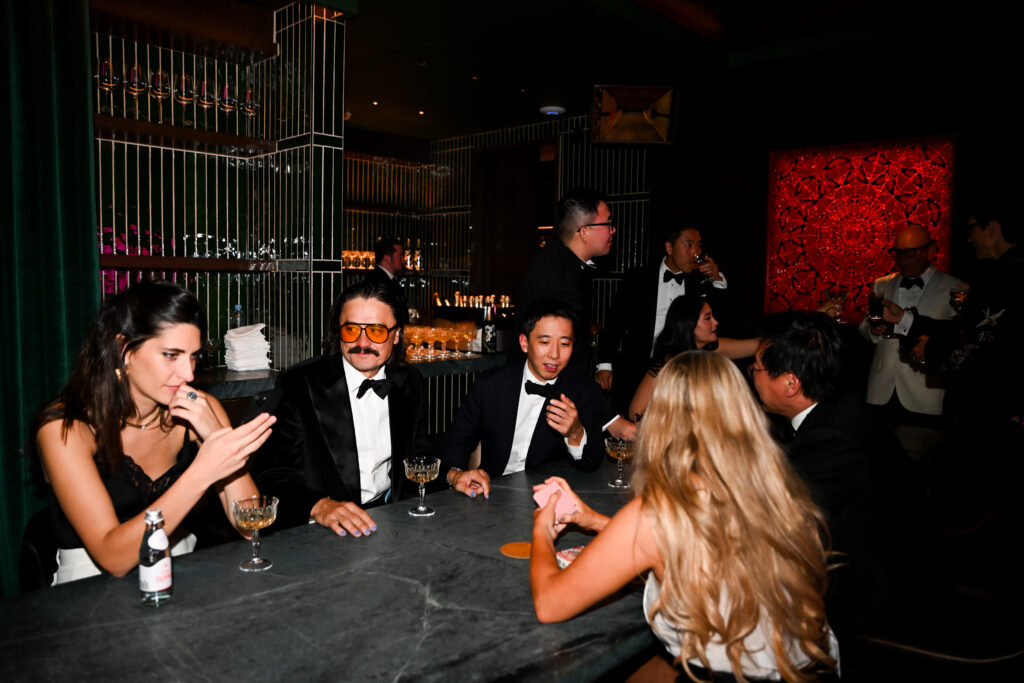
Bar Chimera, one of three new Simon Kim-operated restaurants at 550 Madison, has a trio of bars all to itself — martini, wine, and whiskey — for the mythical beast sporting three separate heads of lion, goat, and serpent. “Your midtown watering hole,” the menu says, and not a moment too soon. (The happy-hour set needed somewhere else to go other than PJ Clark’s.) Philip Johnson and John Burgee’s 37-story postmodern landmark was built in 1984 as the AT&T Building, and in the ’90s became the Sony Tower. Chimera and COTE 550 are Simon Kim’s third collaboration with architects Rockwell Group, who worked on Coqodaq and COTE Las Vegas at the Venetian. The third restaurant will be Masahiro Yoshitake’s sushi house this fall.
“Art is the one element that creates something completely new and unexpected. It offers guests a connection to an artist’s intellect, imagination, and message.” – Simon Kim
Moving around the rooms, Sue Kim and Kwak seem as comfortable as though they live here, with a hug for nearly everyone on the team, and there’s a good reason why. “I’ve known Simon since he was born — he’s my little brother,” Kim says. “He was doing well with the first COTE and we said, ‘Simon, I think this piece should go there.’ He was like, ‘Can I afford that?’ And I said, ‘I think you can afford it now.'” (Which is how they ended up with Emin’s “I can’t believe how much I loved you.”)
“We have very different personalities,” Sue Kim says. She describes her sibling as the “party boy,” and herself as the more introverted, studious nerd. But when it comes to work, the emotional connection to a project is the same. The understanding and trust between them is, she says, profound. “He trusts my vision for art and passion for art, and we were given a lot of freedom. Working with him is exciting and fun, and the art program shows it.”
“We always offer something unique, but at the end of the day, there is only so much we can do to innovate our steak, hospitality, or design,” Simon Kim says. “Art is the one element that creates something completely new and unexpected. It offers guests a connection to an artist’s intellect, imagination, and message.”
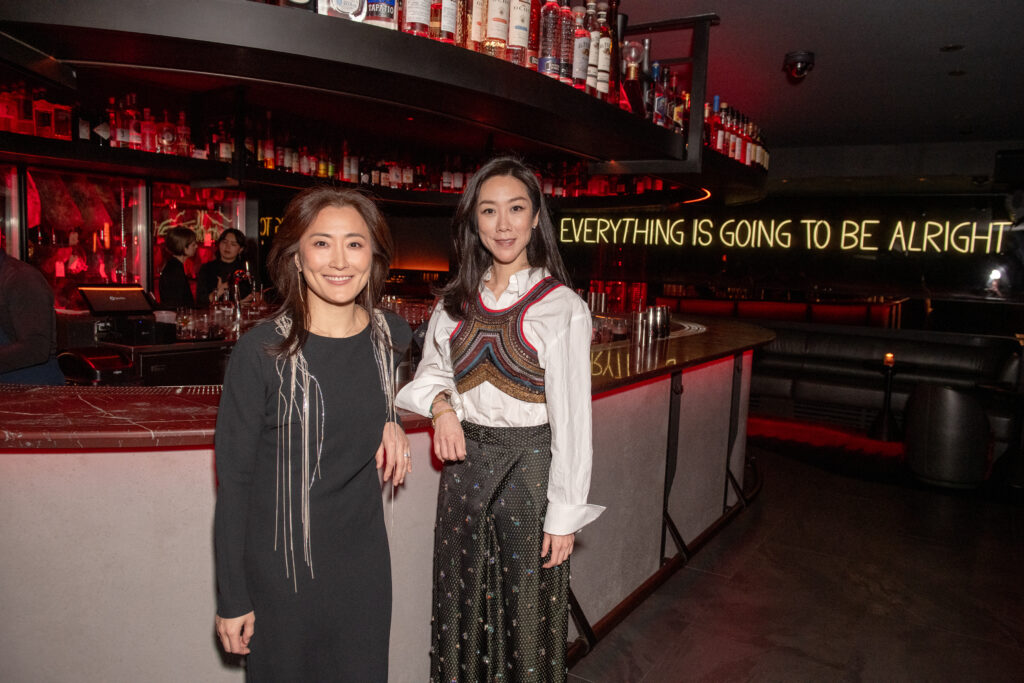
The artwork, he adds, balances the opulence and grandeur of 550 Madison. Another flashing Creed piece, “Work No. 3935 COMING GOING” beckons from the top of the stairs, leading down into COTE 550. The subterranean lair is a return to the heady days of an early-aughts club-restaurant hybrid, and the steakhouse’s second NYC outpost is as moody and club-like as the upper floor is airy and spacious. “Work No. 3937 EVERYTHING IS GOING TO BE ALRIGHT” glows smokily over a banquette. (The Kim siblings both appreciate a play on words; the basement cocktail bar at the original Manhattan COTE is called Undercote.)
For all their different outward demeanors, they like the same things. “We both like strong, bold art,” Sue Kim says. When her brother knows what he wants, she knows it too. For a private dining room at Cote 550, he said he wanted something sexy, so ARTLINE installed a lush, vivid painting, “The Dream from the North,” from Romanian artist Remus Grecu. “He fell madly in love,” Sue Kim says. “He was like, ‘This is amazing, I EFFFING LOVE LOVE, LOVE this, I want it at all my restaurants.’ And we want to get that feeling out of everybody who walks in.”
As Simon Kim says, “I’m extremely extroverted and thrive on constant interaction. She’s more introverted and reserved, with a very strong point of view. Sue and I can finish each other’s sentences, yet the different vocabularies we use to finish them surprise us.”
“I know Simon wants to do Michelin-star-level dining, but he wants to really be authentic to who he is. He wants to be bold and courageous in pursuing his true self and character,” Sue Kim says. “Being a Korean in America, bringing his Korean-ness with his American-ness. And doing it with no reservation, so people can participate in it and not be intimidated.”
Kwak may not be literal family, but she may as well be. She’s known the restaurateur nearly as long as his sister has. “Simon is like my little brother,” she says. “And I’m the second of four, so I know how to navigate. I know exactly what Sue wants and what he wants, and I’m in the middle.”
Kim and Kwak started RplusP Fine Art together in 2012. In 2020, they expanded the public art focus with ARTLINE. They’ve also been best friends since they were around twenty, both having come over from Seoul. “I didn’t speak any English when I arrived,” Kim says.
“Me neither,” Kwak adds. A piano player since age three, music brought Kwak to New York in high school, and it’s through that lens that she still processes visual art. “I’d show her an artwork,” Kim recalls, “and she’d say, ‘Oh my god, it reminds me of Debussy. This painting is Debussy.'”
“A keen understanding of shifting human dynamics in different places really affects how I intuit clients and projects.” – Sue Kim

Between them, Sue Kim and Kwak have the eye and the access to place art well beyond a dining room — residential and commercial, with the kind of budgets and good humor that will get you an Alex Katz stretched across the wall of a top Manhattan plastic surgeon. Kim, who studied art history and cultural studies across London, Seoul, and New York, credits her varied background for her art-buying prowess. “It gives me a very unique perspective,” she says. “A keen understanding of shifting human dynamics in different places really affects how I intuit clients and projects.”
It was in the energy of ’90s New York and the rawness of neighborhoods like the Meatpacking District that Kwak first made the connection between public art and the creative blood of the city. “The exchange between artists, musicians, architects, chefs, designers — it’s all interconnected. The arts are a product of the city’s identity.” Over the years Kwak became integrated with many of New York’s cultural institutions, including as co-founder of the Lincoln Center Family Council and Chair at Lincoln Center Kids & Family Program. “It all reinforced my belief that artists create community and dialogue. When Sue and I began working together, we found our different technical backgrounds often responded to artworks in similar ways. Music, painting, sculpture, an installation — it evokes the same emotions.”
“Someone mentioned to me once, maybe .0001% of people will recognize that’s a Joseph Kosuth, but that’s the power of the artwork,” Sue Kim says. “You can see something that’s beautiful and have it touch you in one way or the other without being aware of it academically. The work is called Paradox, and that’s exactly what we want you to feel.”