“I wanted people to come on the journey with me, to feel it, and then decide for themselves what resonates.”
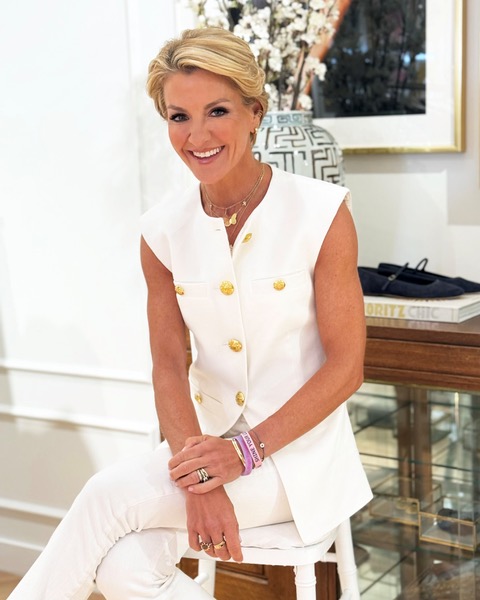
Author Kate Doerge
There are books about grief that offer answers. Kate Doerge’s Reimagining Grief does something far more meaningful discovers TED HILDNER.
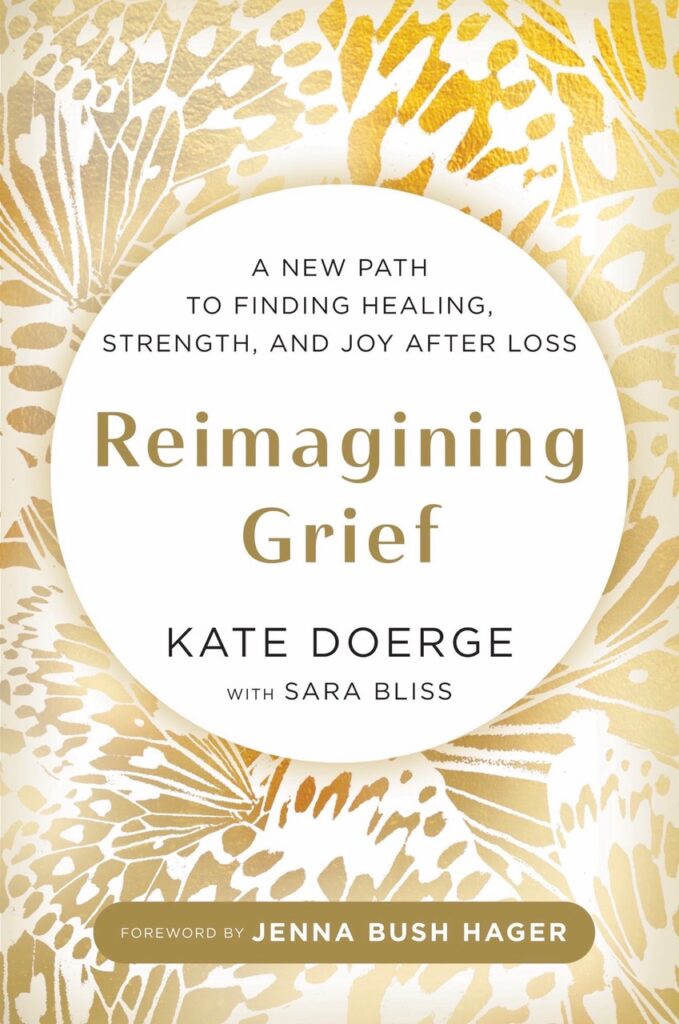
The response to Kate Doerge’s new memoirReimagining Griefhas been immediate and far-reaching. Her book has inspired a movement. Laura Lynne Jackson, Nick Ortner and David Magee have been quick to praise its impact, and Norah O’Donnell is in conversation with Doerge about her philosophy on June 16th at the 92nd Street Y. Tickets are available online through 92Y.
I’ve known Kate and her husband Chad, for years. They are the kind of people you don’t just know but feel lucky to know. Warm, open, deeply connected to their community, and, in every sense, full of life. When I met with Kate to discuss Reimagining Grief, it was a conversation shaped by that history, and by the weight of everything she and her family have been through.
The Doerge’s story begins when their daughter Penny was just four months old. After fracturing her tibia, a doctor discovered Penny had Neurofibromatosis, a genetic condition causing tumors to form on nerve tissue throughout the body. The disease is complex, unpredictable, and, for families navigating it, there is no roadmap. Sometimes the tumors are benign, other times they are malignant and can lead to devastating loss. There is no cure, only a long, uncertain path marked by love, and, in their case, overwhelming loss.
What defines Kate’s story is how she chose to respond to it.
In the final days of Penny’s life, instead of retreating inward, which would have been completely understandable, Kate and Chad did something extraordinary. They opened their home. Friends poured in. Music played. Stories were shared. What could have been a moment of isolation became something else entirely, which Kate now calls a “love cocoon.” A space built not around loss, but around connection. From that moment, Penny’s Flight was born.
What began as a deeply personal way to honor Penny has grown into something much larger. Penny’s Flight is a movement that has inspired more than a hundred youth-led chapters and countless acts of generosity. For those who are grieving, it’s become a place of comfort, offering a positive way to get involved, to connect and to feel supported instead of feeling isolated. At its core is a simple but powerful idea: even in the face of unimaginable grief, there is a way forward, one that brings people together rather than pulling them apart.
“Grief isn’t something to solve. It’s something to carry, and, eventually, to reimagine. It’s a simple idea, but not an easy one.”
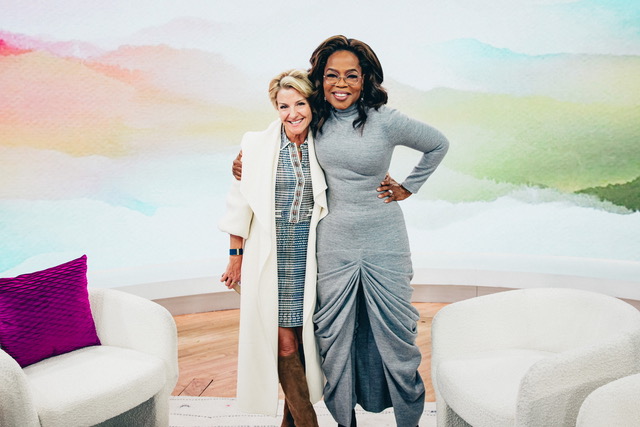
Kate Doerge with Oprah Winfrey
Adam Glassman, the creative director of Oprah magazine, says, “Kate and her family endured the unthinkable. And when the worst happened, she didn’t retreat from the world or allow grief to define the edges of her life. She rose with resilience, with poise, with extraordinary grace. And in doing so, she reminds all of us that courage isn’t the absence of heartbreak. It’s choosing, every single day, to transform it into hope.”
That philosophy is at the heart of Reimagining Grief, which unfolds as a memoir, a love letter and an examination into what it means to continue living after loss. The book resists conclusions. It is not a manual, nor does it attempt to prescribe a singular path through sorrow. Instead, Kate writes with striking vulnerability about her own lived experience. The rawness of early grief, the quiet recalibrations of daily life, and the deliberate choice to remain open to people, to possibility, and, yes, even to joy.
Early readers have been quick to feel its impact. Belle Burden, bestselling author of Strangers, says, “Part memoir, part roadmap, Reimagining Grief, is a deeply personal yet practical guide for anyone navigating the aftermath of devastating loss. Kate doesn’t offer easy answers; she gives us something far more valuable: her own story and proof that a life can be rebuilt, not in spite of sorrow, but through it.”
After reading the book and in speaking with her, what gives Kate so much credibility is how steady her voice is. It never feels performative and she isn’t trying to tell you what to do. It feels honest and experienced. The kind of voice that doesn’t push you, but somehow still moves you forward.
Kate isn’t telling readers how to grieve. She’s inviting them into how she has grieved. And in doing so, she offers something far more valuable than advice. Companionship.
“Grief isn’t something to solve,” she says. “It’s something to carry, and, eventually, to reimagine. It’s a simple idea, but not an easy one. And that’s precisely why it resonates.”
We talked about authenticity, about faith and doubt, and about the courage it takes to put something this personal into the world. Reimagining Grief is about showing people that there is another way through loss, and that you don’t have to find it alone.
In doing so, she opens a door that many people don’t even realize exists. The possibility that even in loss, there can be positive and happy movements. There can be connections. There can be purpose.
Reimagining Grief and Penny’s Flight helps us understand that it’s not our lifespan that defines us, but our individual wingspans, and that even during the darkest days, there can still be light… and the courage to take flight.
“This book is what I wish I had when we were going through our loss. And now, seeing how people respond — whether through workshops, conversations, or even a simple text — it reinforces how much this is needed.”
Penny Doerge
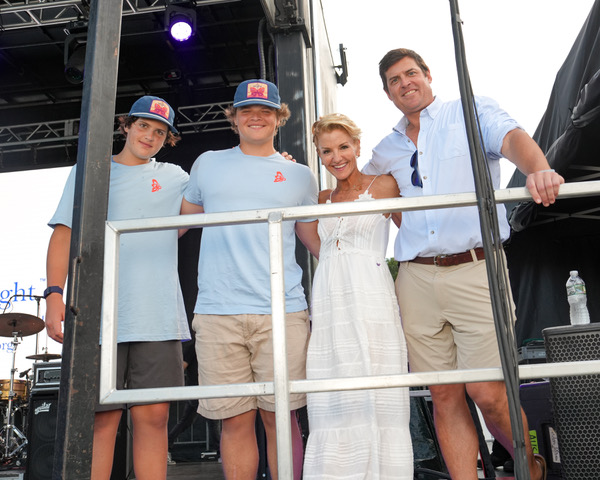
Doerge with her family
The book feels incredibly personal, but never dictatorial.
That was my biggest goal. Authenticity. Grief is not a place where you can be guarded or overly polished. If you are, it starts to feel like you’re telling people what to do. And I didn’t want that. I wanted people to come on the journey with me, to feel it, and then decide for themselves what resonates.
There’s a vulnerability in your writing that’s consistent throughout
I didn’t set out to write a book. Someone told me, ‘You need to tell your story,’ and I thought, I don’t even know where to begin. But I leaned into it the same way I approached everything after Penny. Heart first. And I think when you do that, the consistency comes naturally.
You talk about turning pain into purpose. That’s a phrase people hear often, but your version feels different.
There’s no right way to do it. That’s the truth. But if you lead with authentic passion, it comes through. People can feel that. This book is what I wish I had when we were going through our loss. And now, seeing how people respond — whether through workshops, conversations, or even a simple text — it reinforces how much this is needed.
One of the biggest points you make in the book is that grief isn’t something you “get over.”
Exactly. You move through it. We’ve been taught these five stages: denial, anger, bargaining, depression, and acceptance, but those were never meant to be a roadmap for living. They were observations. What I’m suggesting is something more active. These are steps. Things you can do. It’s participatory. You have agency in how you respond.
Tell me about the importance of taking action.
You can’t control what happens to you, but you can control how you respond. And that applies to everything: loss, divorce, losing a job, anything. The question becomes: What are you going to do with it?
You emphasize connection early on, almost as a first step.
We are not meant to do this alone. Connection is everything. Whether it’s friends, community, a group, or even something like a support network. You need people who can hold space for you. And equally important is knowing who not to be around. The people who drain your energy. Protecting your energy is critical.
There’s also a strong emphasis on movement, both physically and emotionally.
Movement shifts energy. Grief is energy, and if it stays stuck, it becomes overwhelming. So, whether it’s walking, exercising, or doing something active with others, it helps move that energy through your body. And when you combine movement with connection, it’s incredibly powerful.
You also introduce the idea of allowing joy.
It’s one of the hardest parts. People feel guilty. But I always ask, What would your loved one want for you? They wouldn’t want you sitting in darkness forever. They would want you reaching for joy, for light. That shift, thinking from their perspective, can be incredibly freeing.
There’s a spiritual layer to your story, particularly around signs.
That can be different for everyone. For me, being open to signs created a sense of connection. When you’re open, you start to notice things, and whether people interpret that as spiritual or emotional, it creates meaning. And meaning is essential in grief.
You’ve also built an incredible community around Penny’s Legacy.
That’s been one of the most powerful parts. Instead of isolating, we brought people in. And what started as something very personal became something much bigger, something inclusive.The smallest acts can create a ripple effect. That’s what I call the butterfly effect. And that’s how communities grow.
Who do you hope this book reaches?
Everyone! Because grief isn’t limited to one kind of loss. And these tools of connection, movement, purpose, and perspective apply whether you’re 10 or 80. It’s not about your lifespan. It’s about your wingspan, what you do with your life, and how you impact others.