“It operated as a school recently enough that at the opening party, alumni milled about under the spell of their own memories. Salvatore Ferragamo was a student, as were Stefano Ricci’s family, Emilio Pucci’s offspring, and generations of Italian nobility.”
At Auberge’s first Italian property Collegio alla Querce, JANET MERCEL finds a noble palazzo—once home to squatters, raves, and the children of Ferragamo and Pucci—reborn as 83 rooms of frescoed, oak-marked splendor.
Collegio alla Querce only opened last year, but its entrance has already achieved legendary status. Cinematic cypresses wind away from the hum and dust of Florence, along the drive that takes us up, up, up the hill to the wrought iron gate that greets us with baronial majesty. Le Cure is just a twenty-minute taxi ride from the airport and a thirty-minute walk into the city center, but this neighborhood is where the edge of metropolitan life melts into countryside. Up here, we are a world away from all that.
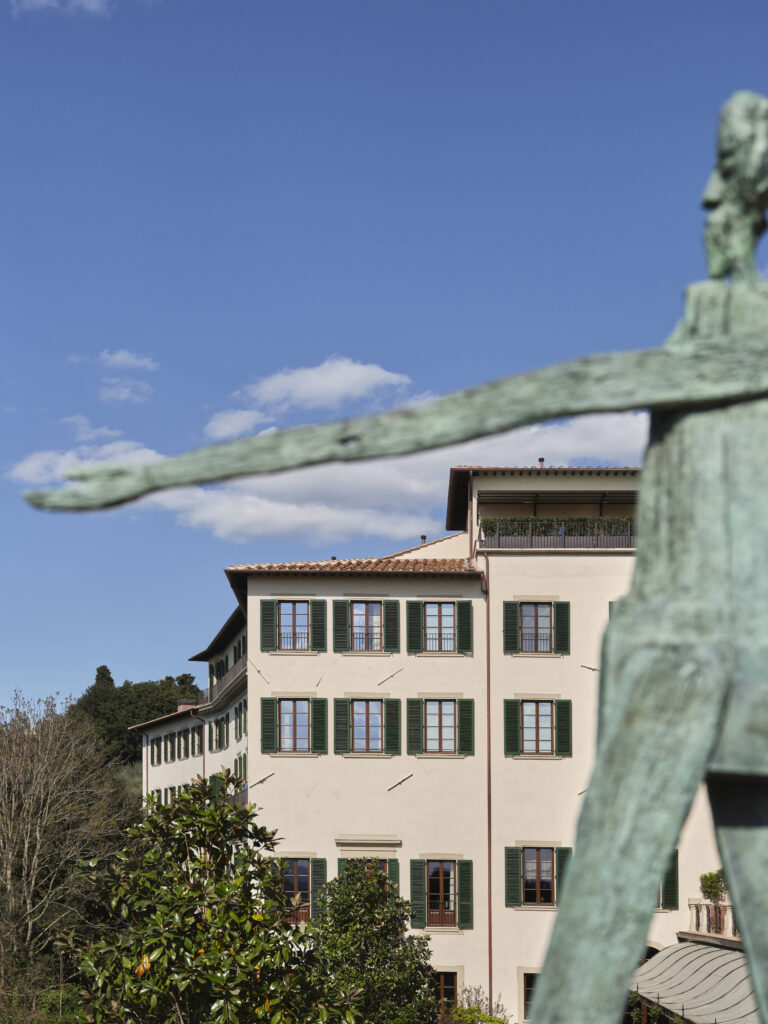
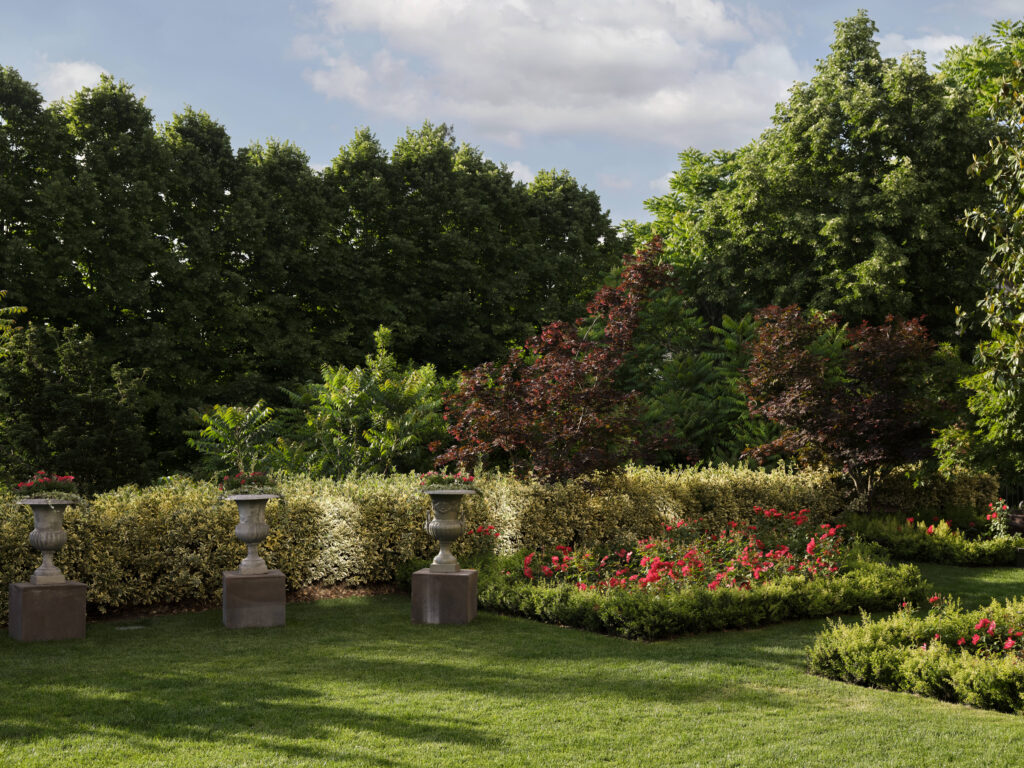
We crunch across pearly gravel through tiers of Baroque gardens, toward the copse of 16th-century buildings. It carries all the grandeur of great literature—Manderley, The Thorn Birds’ Drogheda, Brideshead—especially when a shimmering olive 1979ish MGB roadster swings in next to us and a small pile of indecently tanned Italians in white spill out. Collegio alla Querce is Auberge’s fourth European property, its first in Italy, and has been awarded two MICHELIN Keys.
Revived from the late June heat with cool towels, we’re led through hushed corridors to our guest quarters—yes, quarters, passing through room after room of impressive ceiling heights befitting a 16th-century noble palazzo. Many of them feature original frescoes. Plaster crests climb the walls up to the marble arches. Trees in heavy pots stretch towards the skylights in the Conservatorio. Every sconce has a Venetian fabric screen. We pass a trophy case with brown leather cleats and rugby balls—alumni memorabilia from the ghosts of Florentine aristocracy. Patterning the floor at what was once the original entrance is an enormous mosaic of an oak, the DNA of the whole operation.
The “College at the Oaks” is named for the local trees, but also something more mystical. According to a legend circa 1520, the Virgin Mary appeared at a nearby oak tree to heal someone praying to her. Then the site became a holy place of worship. A private villa was built around 1400 and was expanded into a mansion by a noble family in 1775. The Church acquired it in 1868 and ran a boarding school for over a century before it sat abandoned for two decades, though it was technically still under the friars’ care until around 2015. It operated as a school recently enough that at the opening party, alumni milled about under the spell of their own memories. Salvatore Ferragamo was a student, as were Stefano Ricci’s family, Emilio Pucci’s offspring, and generations of Italian nobility. Even after the pupils left, the dormant estate was far from still; plenty of Florentines remember the squatters and aughts-era raves that took place high on the hill, within its deconstructed walls, before the hospitality developers arrived. The restored chapel and theater now host students from the Scuola di Musica di Fiesole and the Fondazione Mascarade Opera, who come up to rehearse and perform.
“Auberge works within Italy’s Cultural Heritage Code to recover as much of the school’s original art as possible—you’ll feel like you’re spending the evening in a particularly cozy wing of The Frick.”
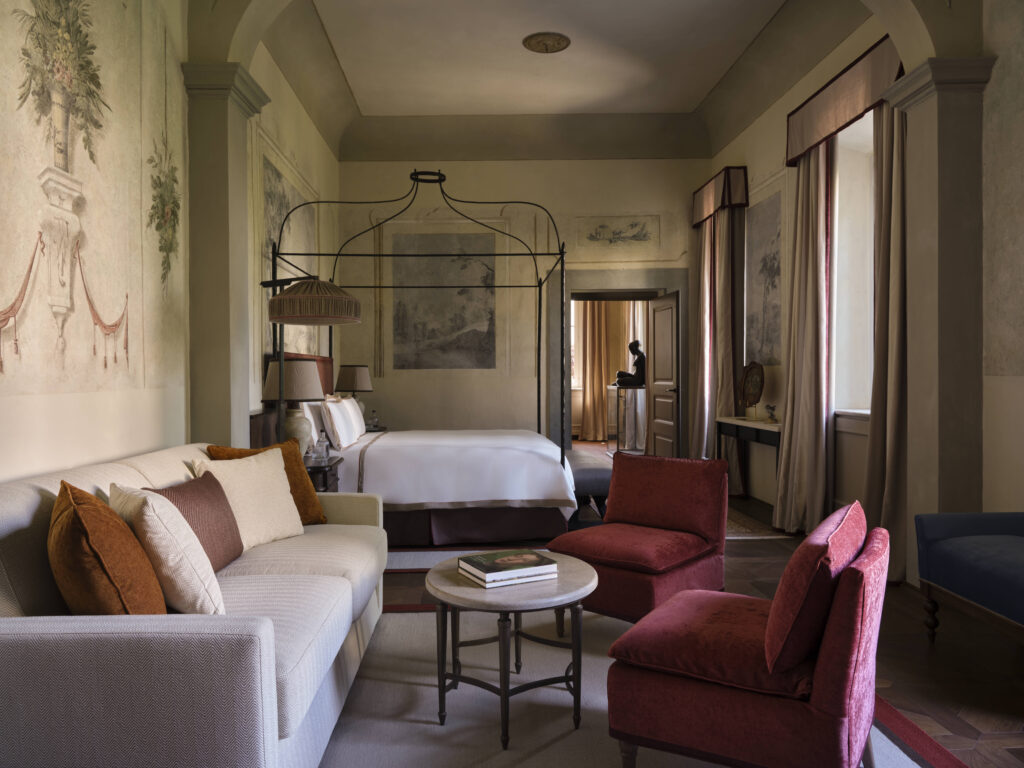
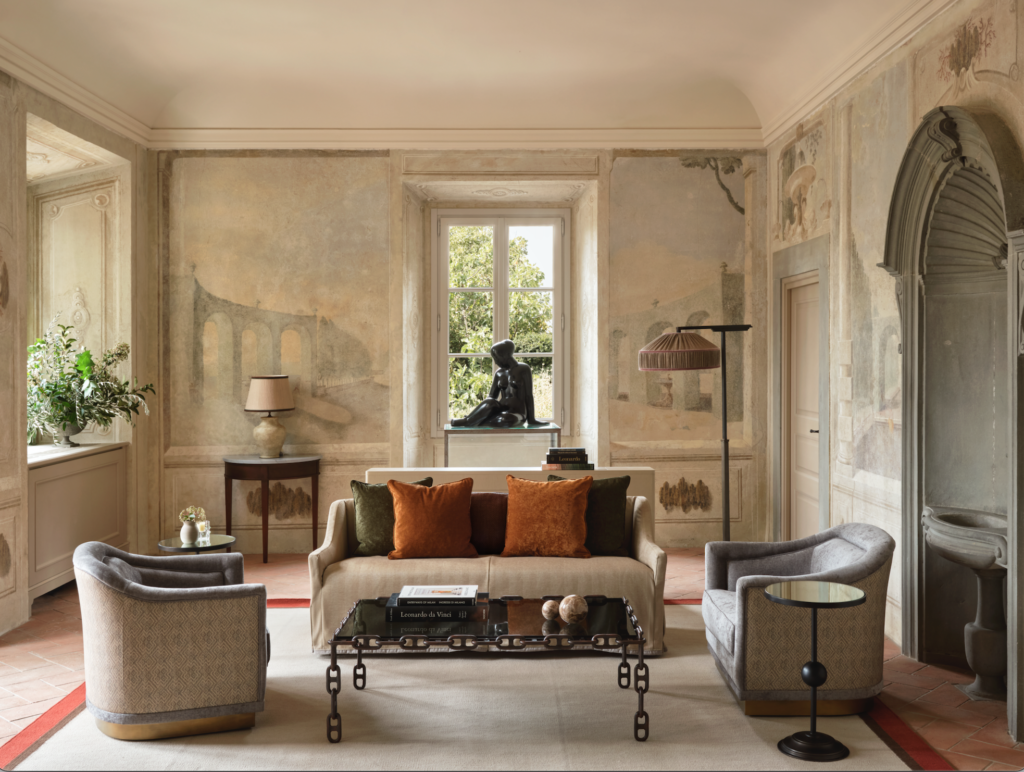
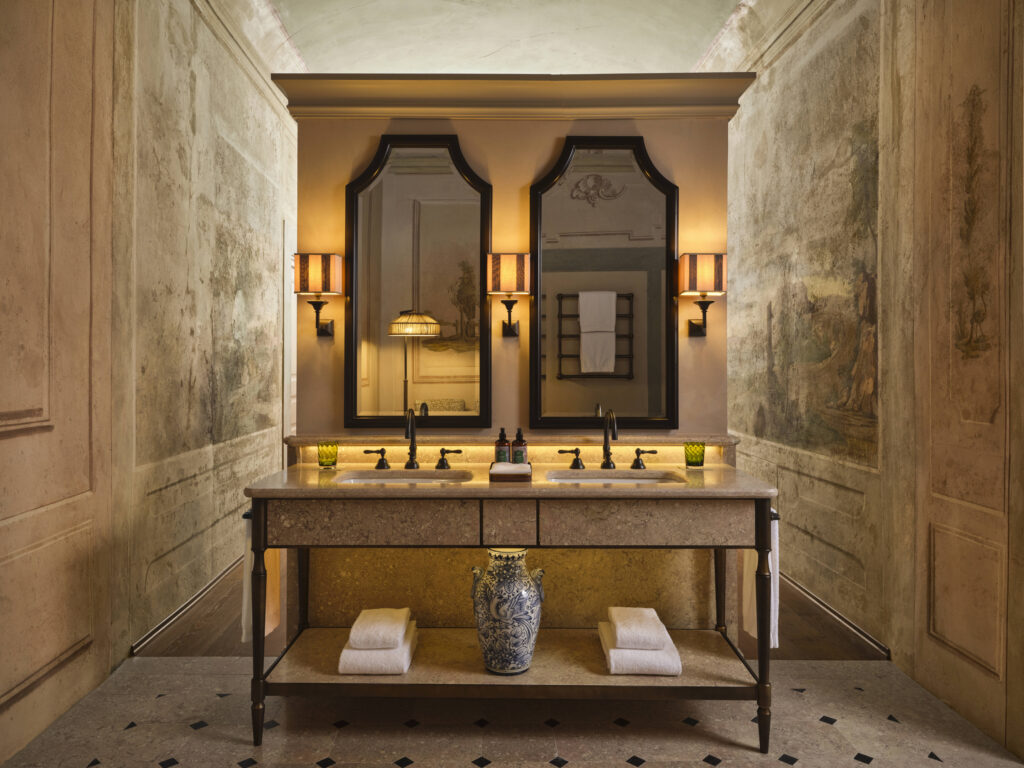
Our suite is the kind that requires a tour, and not just to show where the light switches are. Off of the foyer is the first walk-in closet (there will be more). It doubles as a wine room, upholstery-paneled and climate-controlled. Between the washed wood millwork and slate blue walls with sumptuous draperies, you could be wandering a classic six on the Upper East Side, outfitted for full-time life. Except for the astonishing view: on one side, the ancient acreage spools out clear to the vineyard landscape of Chianti. On the other, the roofs of the cityscape and spires of the Duomo.
In the sitting room, the wooden shutters that flank the fireplace are flung open to the spread of Tuscan hills. On the dining table is a fleur-de-lis dusted tea cake, oak-tree monogrammed linens, and a plate of cookies spelling out my daughter’s name in jade green icing—the first of many opportunities for her to receive the royal treatment. Sloane’s wood crib is made with the same custom Rivolta Carmignani linens as our plush king, with the addition of a tiny wooden Pinocchio (Florence!) tucked into the layette blanket. My husband immediately ices a pre-batched Negroni from the mahogany not-so-mini bar, cracking open Tartuffo truffle cashews, Cerignola olives, and fennel taralli cookies.
We barely unpack before heading to the largest hotel pool in Florence—115 feet long—it’s across the courtyard that used to be athletic fields. Lined with glossy olive trees, ivy-covered walls, and the smell of outdoor wood-fired pizza, it doesn’t feel resort-y. It feels more like strolling a very generous friend’s private home. After an hour or two in the sun, we drag ourselves back inside; we have a pasta-making lesson. I’m reluctant to abandon our outdoor oasis, but I needn’t have worried. The open kitchen at La Gamella—meaning “school canteen,” which it was—is as romantic as the rest of the villa: it’s all classic Tuscan tile, plus copper pots and crockery.
Sous Chef Mirko Cafasso is waiting with aprons and a teeny chef’s hat for Sloane. He helps her navigate her three-year-old fingers through fresh orange egg yolks in splatterware bowls full of semolina flour, melts sage in butter, and shows her how to roll ricotta into her dough and turn the crank on the pasta maker with unearthly patience—at least to this American. His “pay attention, Chef!” whenever she loses focus (often), is somehow both commanding and funny. Executive Chef Nicola Zamperetti peeks in on her progress. With two charming chefs to focus on, my tiny daughter bats her lashes so hard I can feel the breeze. After all, her blood is half Italian.
Collegio has 83 rooms, many with original frescoes, murals, and marble floors. Each of the six sprawling grand suites, adapted from former classrooms, is one of a kind: with a rooftop terrace, two full stone-lined baths, or, like ours, a private wine cellar where the sommelier (lured from the Four Seasons) will customize your program before you arrive. As the sun sets, two friends, both local Florentines, join us in our suite for aperitivo. One of them, a third-generation antiques dealer, points out an ancient Chinese Bi disc on a side table. The hotel owner is a collector, and the entire place, even the guest rooms, is filled with his personal artwork and objet d’art.
“It carries all the grandeur of great literature—Manderley, The Thorn Birds’ Drogheda, Brideshead—especially when a shimmering olive 1979ish MGB roadster swings in next to us and a small pile of indecently tanned Italians in white spill out.”
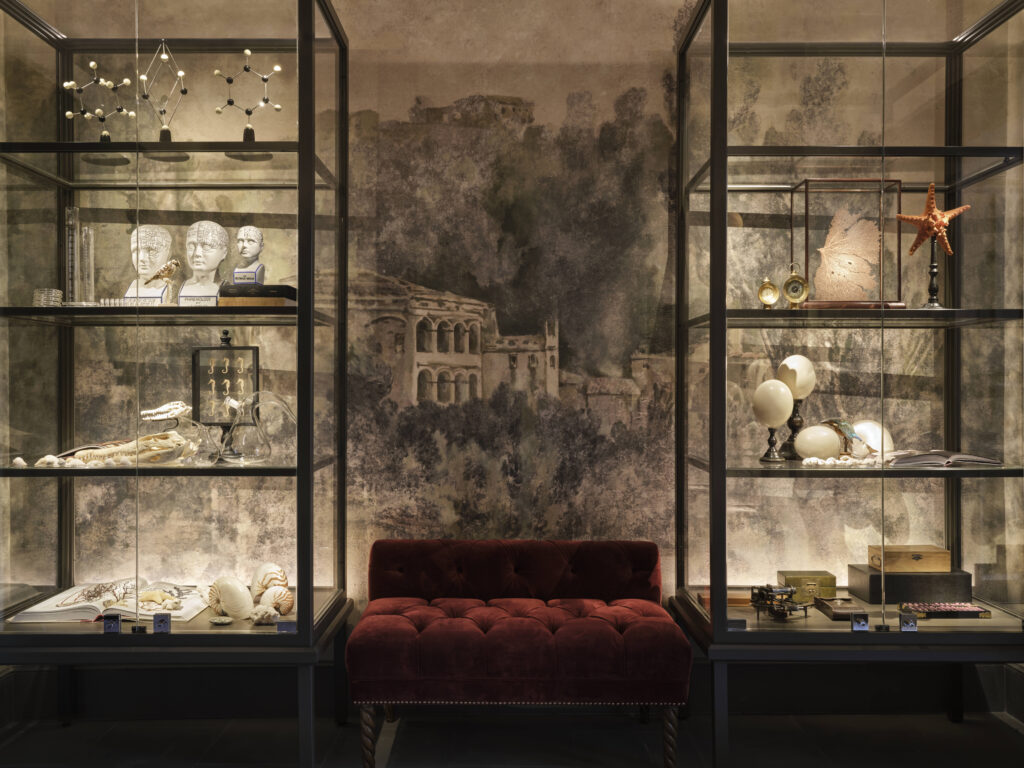
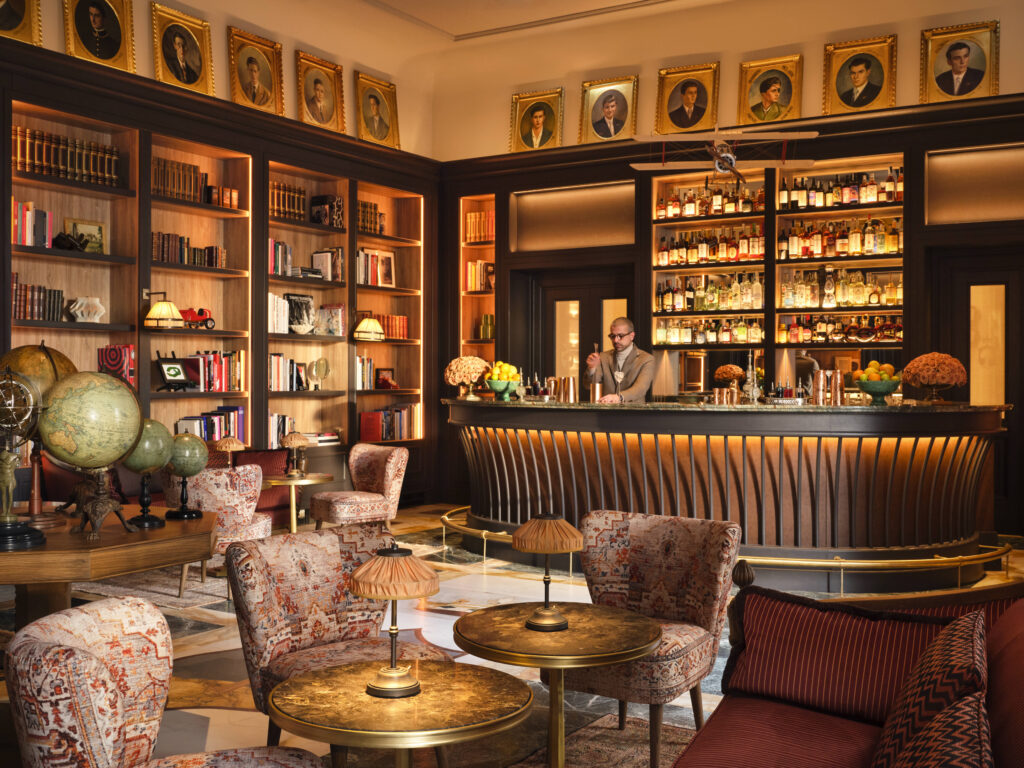
Downstairs in Bar Bertelli, formerly the office of headmaster Timoteo Bertelli, bookshelves and vintage globes glow along the walls. (The astronomer taught here from the late 1860s until he died, save for a brief stint in the 1890s spent directing the Vatican observatory in Rome.) Hidden in the walls is the door to Florence’s only cigar lounge and grappa room. A frieze of oval-framed student portraits peers down at us while we sip ginger-infused gin and wild mezcal. Auberge works within Italy’s Cultural Heritage Code to recover as much of the school’s original art as possible—you’ll feel like you’re spending the evening in a particularly cozy wing of The Frick. Rousing Sloane from her nap on a green velvet sofa, we leave our friends to their discourse on Chinese antiquity and Italian artistry and head down to a very late dinner.
La Gamella shifts at night from garden atrium to fairy-lit enchantment. Arancini, focaccia, and fresh cherry tomatoes with olive oil, then comes the tonno alla pizzaiola—Mediterranean bluefin tuna tartare with roasted tomato, capers, olives, and oregano—and grouper with fennel, orange, wild fennel pollen, and taggiasca olives. Sloane doesn’t realize the impeccable man who strolls by to chat with her about gelato is Lorenzo Maraviglia, the hotel manager. We try two kinds of grappa before rolling off to our turned-down chambers.
In the morning, breakfast is in the kitchen and garden, keeping the cherished-guest feeling going. The Tuscan market has come indoors: boards of sfogliatella, plump as puffins, sit next to strawberries and Nutella. Mushrooms, potatoes, and sausages warm on the stove. The farm table is covered with roasted peppers and zucchini, crudités, and lox with baskets of bread. A wheel of Parmigiano-Reggiano the size of a car tire sits beside silken blocks of feta.
As Sloane says goodbye to her new friends, I’m silently thankful our next stop is to stay with friends in their home. After Collegio alla Querce, it’s the only thing that could possibly feel right, and saves another hotel from an impossible act to follow.