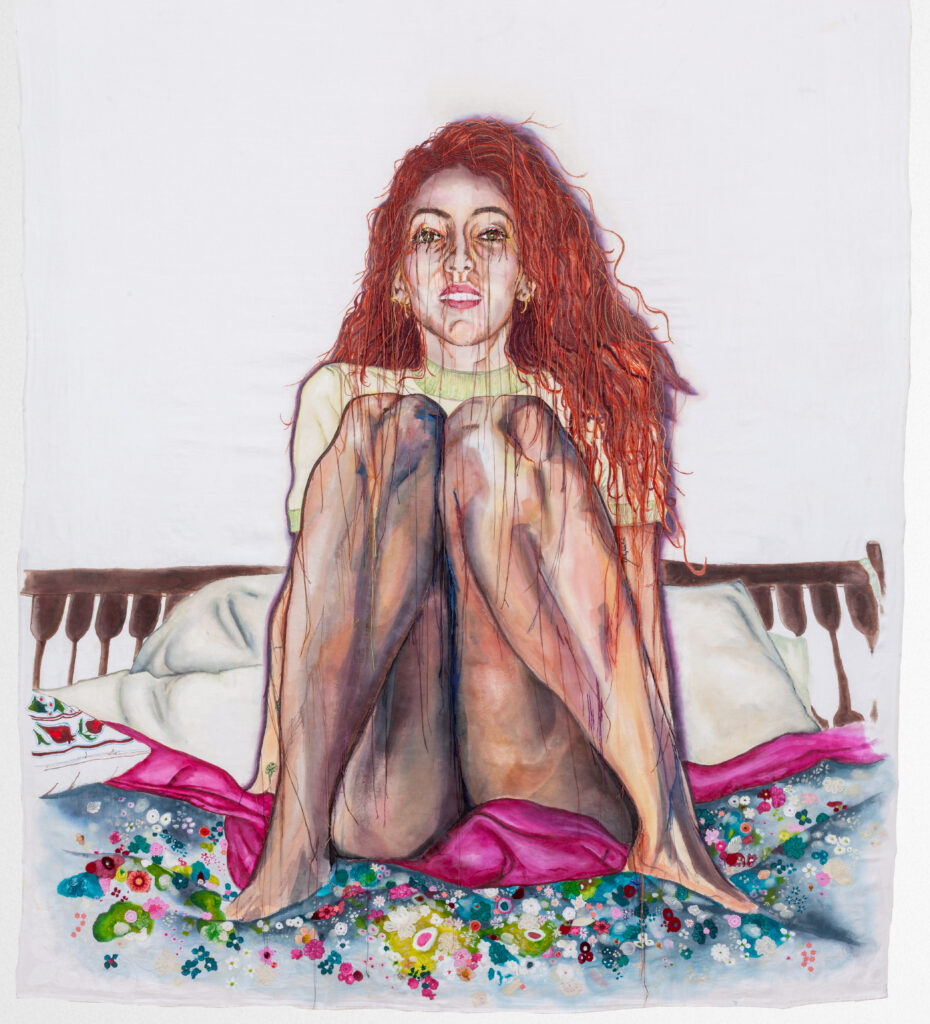
“I was 21 when people started chatting shit about me online. I’ve been developing a thick skin to people saying nasty things about me for over 20 years, and that’s probably served me well.”
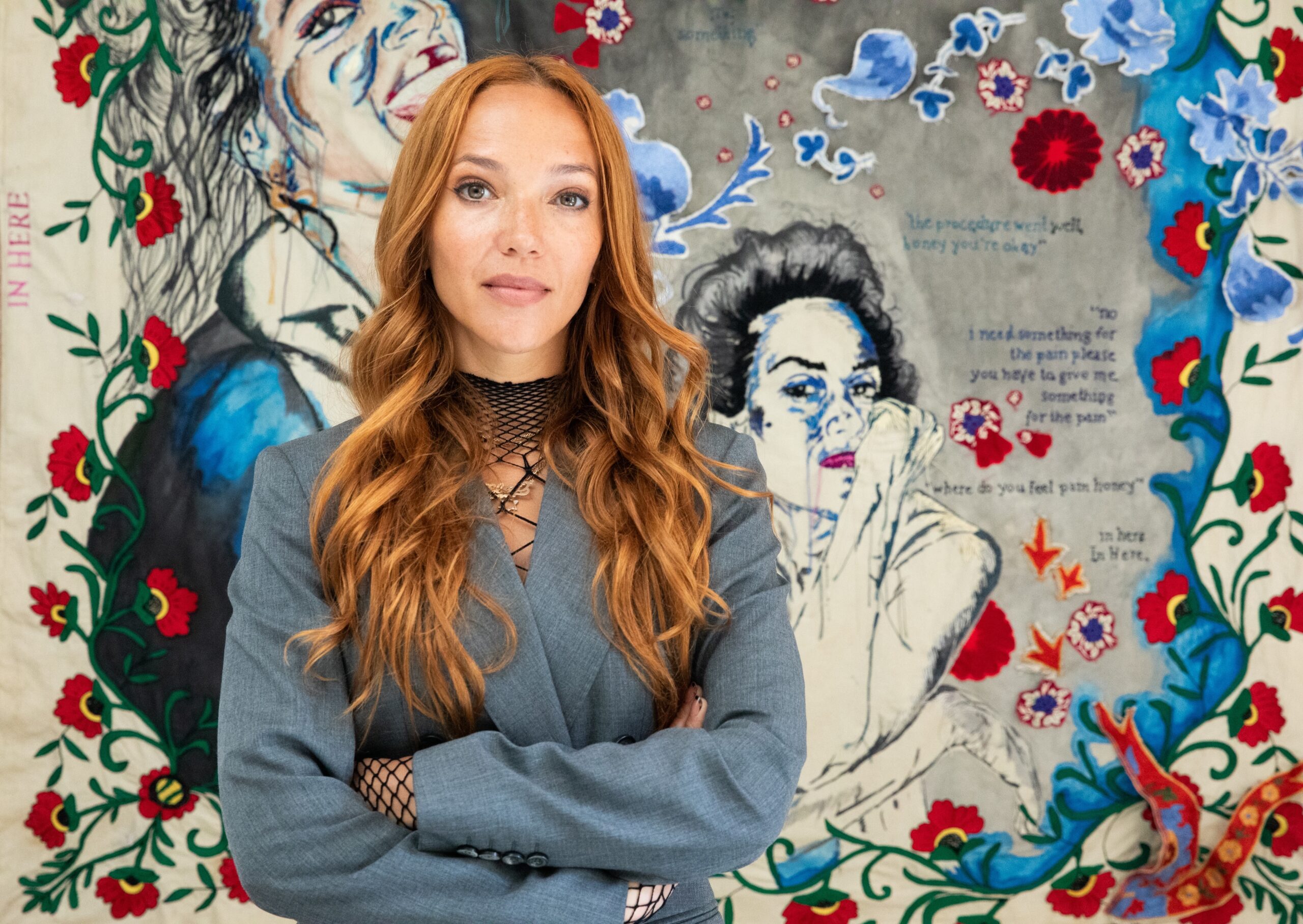
With her first Miami solo show, “Who By Fire,” Zoë Buckman trades boxing gloves for damask and grief, and finds softness—even for men.
BY JANET MERCEL
While standing in Mindy Solomon Gallery, Zoë Buckman talks me through her first solo Miami show, “Who By Fire,” her Hackney accent lilting up and down. She points out the long strands of thread trailing out of an oversized “canvas,” a reclaimed damask tablecloth.
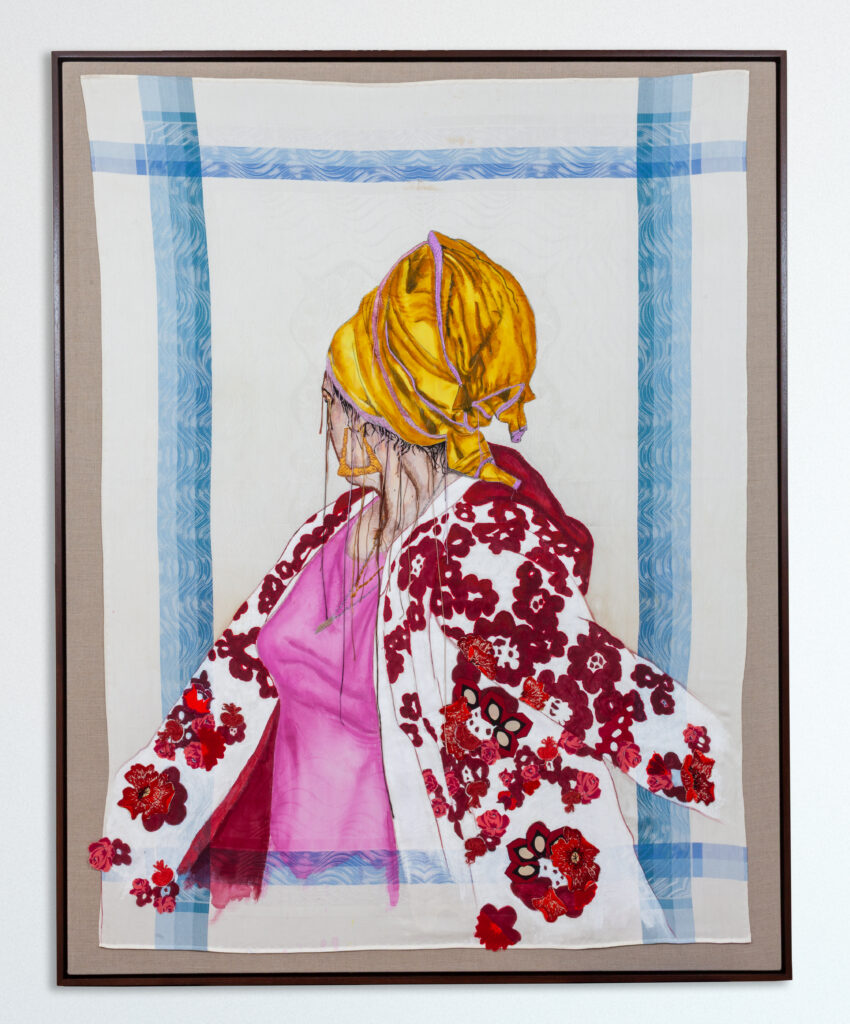
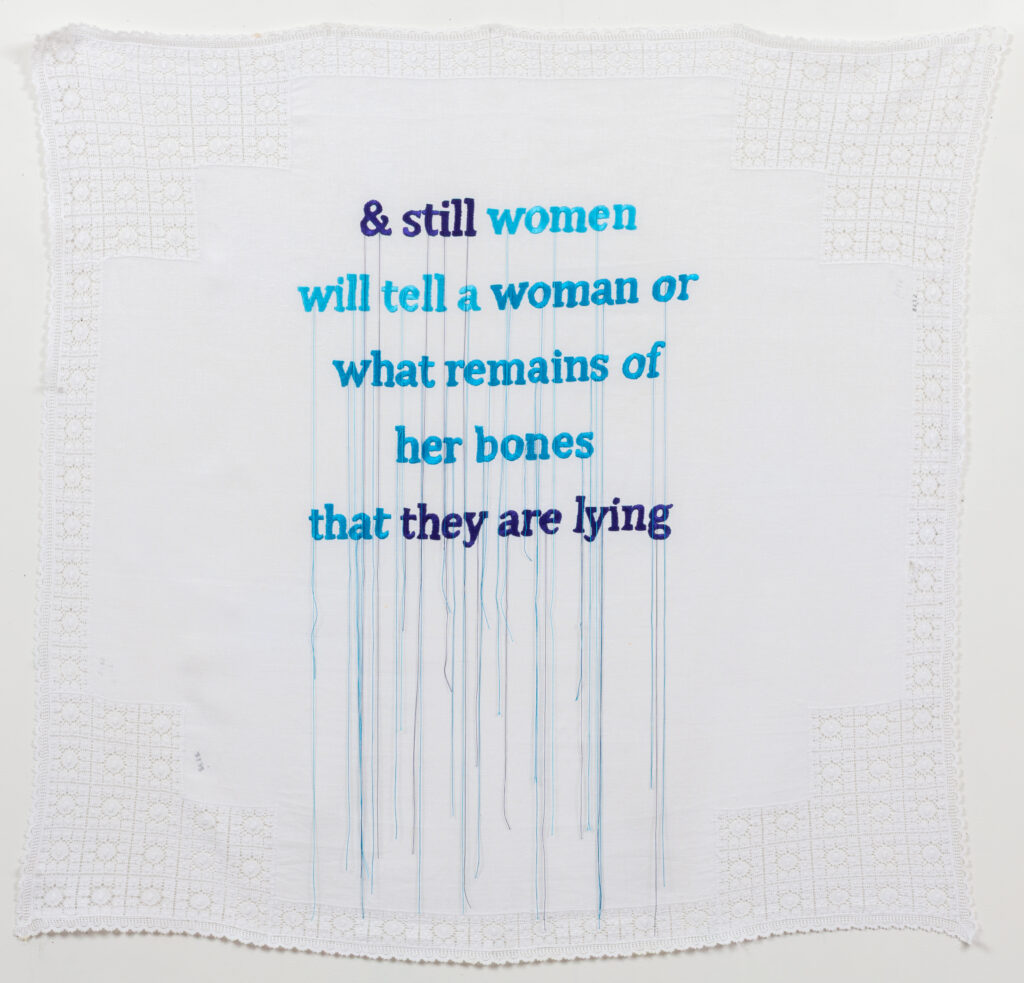
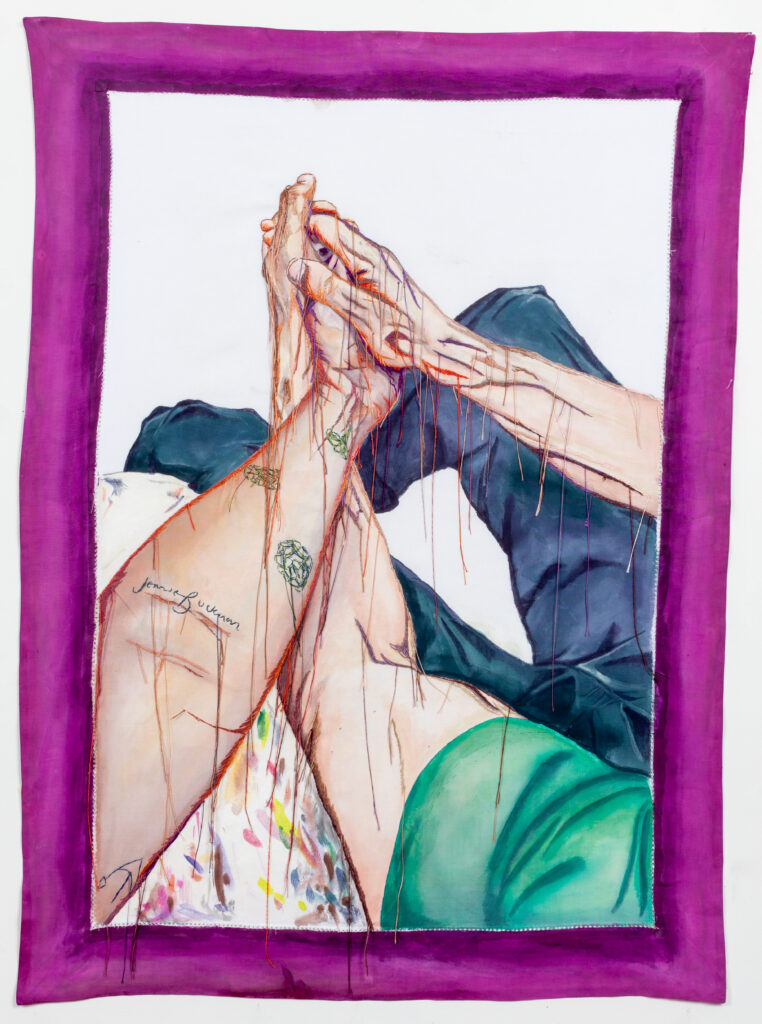
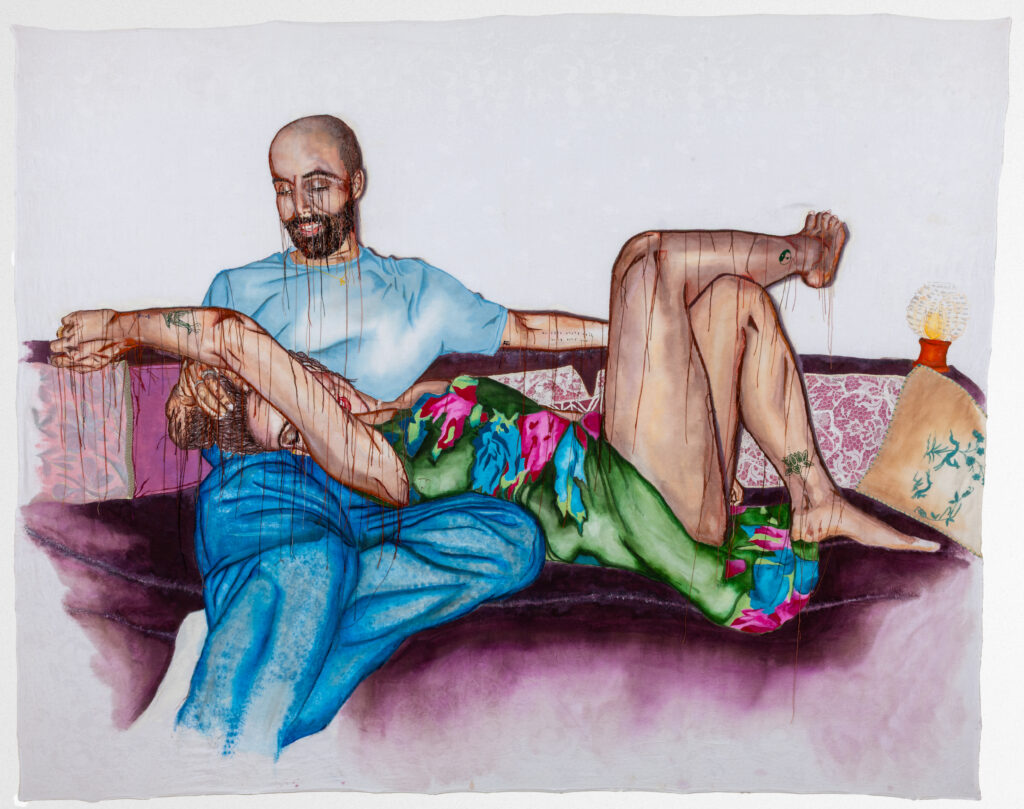
“I use mainly acrylic and ink, which obviously bleeds onto the fabric. I started embroidering them, and I was enjoying that loss of control and freedom, also trying to harness it. I started to use the threads from this side,” her hand gestures over the face. “It’s like diving in from the front as opposed to the back, which is why there’s these that come loose. It’s very much about this feeling of everything coming undone, anyway. That everything’s in flux.”
It approaches deconstruction; the layers of appliqué and visible stitching asking to be touched. Buckman’s work often features the traditional trappings associated with the softer sex—vintage lingerie, discarded bridal gowns—while poking holes in lazy cultural contradictions of feminism, body autonomy, assault, and trauma. This show feels more forgiving. They are portraits of herself; her friends and loved ones caught in intimacy. There’s one of actress Jemima Kirke lounging on a Brooklyn bed, and one of Buckman’s hands, tenderly intertwined with those of then boyfriend, now fiancé, surgeon Justin Saliman. The portrayal was a boundary of discomfort Buckman forced herself to move through. “At least with my work, I’m showing a bit of softness when it comes to men. I’m more open to allowing for some men, where it’s not just me talking about all the shit things they’ve said and done to us.”
The attention is on more humble textiles: table linens, tea towels, and the less glamorous articles of bridal trousseau for centuries. You can easily visualize the artist toiling and laboring with a needle, which is the point. “I was here, right? It’s not just a picture of two people; there is all of this time and this work. My work is very much about the labor of what it is to be in these bodies and these identities.”
The sheer effort involved with embroidering—the largest pieces took over six months to produce—means Buckman is not envisioning another show like this any time soon. The works are bigger than many of her previous ones, which she acknowledges is coming from a gradual willingness to take up more space. They are a study of grief, love, joy, pain, loneliness, and friendship, as well as finding and creating sanctuary, all through the commonality of being a woman. In her case, a Jewish woman. The show title comes from Leonard Cohen’s song about the prayer “Unetaneh Tokef.” Buckman’s loss of her mother, the acclaimed London acting teacher Jennie Buckman, in 2019, was the crux of an exploration into faith. Although while growing up, Jewishness was not a big part of her experience.
“We were super secular,” she says. “We would maybe do Passover, but it was always a bit irreverent…then when my mum was terminally ill, I watched her put on the most legit Seder I’d ever seen her do. I realized that it was because she knew she was dying. There was this feeling of, she wants to get this right. I think she wanted to get it right with the divine, if there is one.”
“It’s really about this one relationship that I was in for two years after my marriage, and there was violence and sexual assault, and definitely emotional abuse, as well.”
Making art about religion is not without its pitfalls. Buckman, whose work shows internationally from SFMOMA, The Broad, The National Portrait Gallery, The Jewish Museum, The Parrish Art Museum, Studio Museum in Harlem, Paul Kasmin, Jack Shainman, Fort Gansevoort Gallery, Lyles & King, The National Museum of African-American History & Culture in Washington, DC and many others, came face to face with the consequences in 2023. In the immediate aftermath of October 7, her former London gallery, Pippy Houldsworth, chose not to hang a self-portrait featuring a Star of David necklace.
“I think everyone was freaking out and not knowing how to handle it and feeling like, what if we’re put on the spot? What if someone throws paint at this? And I was like, we’re all fucked up right now. It’s okay. They eventually did exhibit it in Miami Art Basel that year, and it sold.” Then, while in the midst of a large push of work, the gallery cancelled Buckman’s solo show. “They were like, yeah, we want to wait until London is less anti-Semitic. And I said, ‘So, never? I’m never going to have a show in London? I’m only from there.’”
The work, somewhere i swear i can hear the siren of a kettle boil, ended up in Miami, where Buckman will have another solo debut at the Pérez Art Museum in October, coinciding with the release of an art book, Thick Bleach & Euphemisms. Show Me Your Bruises, Then is a 17-minute video installation, the performance of a poem Buckman wrote after an abusive relationship. It features herself along with actors Cush Jumbo and Sienna Miller. “It was about bleeding and bruising and having your power taken away from you…it’s really about this one relationship that I was in for two years after my marriage, and there was violence and sexual assault, and definitely emotional abuse, as well.”
Familiarity with Buckman’s work will show you a consistent subversion of the feminine and masculine, violence and peace. Hip hop lyrics emblazoned on delicate underwear. Beribboned boxing gloves and visions of wounds in lush fabrics that almost (almost) obscure the darkness of the theme. It is still somehow shocking that these experiences took place nearly in real time, after her well documented divorce from actor David Schwimmer. Rather than 20 years ago, or in the backwater of coming of age, where most of us like to believe trauma was left behind long ago. Equally shocking is her ability to share, when naming abuse usually comes with terrific consequences. Too often our media feeds sound like an old satirical Reductress headline: “Man Who Hurt You Upset You Told People He Hurt You.”
There’s a 16th-century proverb, “You can’t make a silk purse out of a sow’s ear,” about the impossibility of transforming something fundamentally bad into something good. Buckman has found a way to do just that. She is a beautiful woman making beautiful art about ugly things; less about any particular cultural reckoning in time and more about what it means to exist.
It was Sienna Miller who encouraged Buckman to appear in the film Show Me Your Bruises, Then. “She said, Zoë, this is your poem. This is literally your story. And anyway, it’s not acting, come on, just read it…and I shared it with the curators of the Pérez. They said they want me to be the one to hold this very important conversation about the gray areas of sexual assault. There are these wavy, confusing, muddy issues of consent within the context of a relationship. That’s not really explored much anywhere, especially not in the art world. These things had like five minutes of attention right after #MeToo. There was going to be all-female group shows and museums. What the fuck happened with that? Nothing. But the Pérez has got fucking balls, and they said, ‘we want it.’”
“There are these wavy, confusing, muddy issues of consent within the context of a relationship. That’s not really explored much anywhere, especially not in the art world.”
It’s many tens of degrees colder a few weeks later, when Buckman leads me into her studio on the ground level of her Brooklyn townhouse. I unthaw with hot tea with a plate of powdery sugar biscuits. One of her signature installations, a tumble of boxing gloves upholstered in lurid textiles, hangs in a corner while we unpack her relationship to controversy.
“I was 21 when people started chatting shit about me online. I was cocktail waitressing, making bad art during the day, dating a famous person. I’ve been developing a thick skin to people saying nasty things about me for over 20 years, and that’s probably served me well,” Buckman says. “Around the time I started to be labeled as a feminist artist was also around the time [2016] that I started to grow very alarmed with what was happening to our sex. This global war against us and mistreatment of us and subjugation of us, the rescinding of our rights and all of that.”
“I’m making work about this injustice and inequality…and I’m also seeing this growing pressure on women to overshare…I started to say, ‘all right, Zoë, you need to make sure that every piece that you make—is this what I’m trying to say? Is this the right way? Is this the right time? Am I the right artist to tell this story?’”
On the one hand, the warmth and hospitality of her home stands in direct contrast with the ugliness of our words. On the other, it’s a perfect paradigm of the female experience and her work: brutality and ugliness alongside a porcelain cookie plate and a cup of tea. “Some of us feel this pull to spill our guts and go, ‘this is me. Look at me. This is what I have to say and whatnot,’” she says. “I think that it’s a little bit more interesting to take that impulse and start to go there, but then also pull back a little bit. Invite people into the conversation and bring them towards you. With artwork as well, often the power is in what isn’t shown. I’m trying to walk that line.”
Buckman understands there can be no light without the dark; the need for light is even greater within the dark. Beauty has always been one of art’s most powerful tools for telling the truth, and she doesn’t pretend something pretty protects you from psychic damage. She simply creates work that refuses to collapse under the weight of its subject, holding the viewer in its unpleasantness long enough that they don’t look away.